
Hombre & Mujer
Tips to improve game reading for sports trading



Several factors influence the results obtained by the sports trader. One of the most important is, without a doubt, game reading. This is the activity of analyzing the behavior of teams in search of valuable inputs.
Of course, it’s no use having an excellent game read and ignoring other essential aspects such as bankroll management (that is, the way you manage your capital in your bets) and emotional control. However, without a doubt, this is a fundamental factor for a bettor’s success.
Thus, you can refine your observation and improve the quality of your bets, regardless of your favorite trading strategy, click for info about online casino in Naija
What is game reading?
Game reading is nothing more than observing what happens in a football match to identify good betting opportunities. In general, it is useful both for the sports trader and the punter who decides to act on Live.
Important to mention that the game reading in sports betting differs from what we see in television commentators. When watching a game from your couch, it’s okay to see who has the ball and shoots more on goal, but that often may not be enough to earn a ticket.
We, bettors, need to pay special attention to some details such as the recovery of the second ball, the passage of the full-backs in the offensive field, and the marking used. When you watch your team play over, do you look at these details? Most likely not!
Game Reading for Sports Trading: How to Analyze Marking?
The first aspect of monitoring in your game reading as a sports trader is each team’s marking to retrieve the ball. Even if you work with the Back to Favorite strategy, you cannot ignore marking: the first step to make a profit is not to concede a goal against your position.
Another essential tip about marking is that possession of the ball doesn’t always mean that a team is doing well on the field. It could be that your opponent’s strategy is precise to draw back the lines and set up counterattacks. If you ignore it, you can be in a bad situation in the blink of an eye.
Football teams use three types of marking: pressure, compact, and zone. Let’s understand each of them from now on.
Pressure marking
Pressure marking is one of the most efficient aggressive and goal-seeking teams. It consists of pressing the opponent’s ball out, scoring in the attacking field. The objective is to leave no space for the opposing team to construct their move easily.
When well-executed, it brings an enormous risk to the opponent, which is to recover the ball already in the attack field, close to creating a goal chance. However, it also has its risks. We can mention the need for the excellent coordination of the team and the spaces left in the defense, which you can exploit if the opponent has a good ball exit.
It’s worth mentioning that it’s not because a player puts pressure on the opponent that you have a pressure tag. A team must have many players in the attacking field to execute it, creating organized pressure and not letting the opponent breathe when the ball goes out.
Compact marking
The second type of marking you should know when performing your game reading is compact marking. As the name suggests, this is the most recessed type of marking, in which the defensive lines and midfield are very close. It can be done with either a high or a low line.
The main objective of this defensive strategy is to press the player with the ball when he is between these two lines. It is also perfect for making it difficult for the opposing team to infiltrate inside since it is difficult to «break» these marking lines.
The risks of this marking strategy are the opposing team’s quick touches (capable of breaking the lines) or quick game reversals, catching exposed sides. It forces the cross and kicks from a medium distance a lot. It is also something to monitor depending on the opponent’s offensive characteristics.
Zone marking
Finally, we still have zone marking as a third defensive strategy. In this model, each player takes care of an area of the field without accompanying an opposing athlete. When he «leaves» his zone, the responsibility passes to another partner.
The great advantage of marking by zone is maintaining organization, preventing a marker from running after the opponent and leaving spaces. Although it is being used less and less, it is very effective against teams that like to play the ball.
The big challenge in applying this marking is team coordination. Any mistake can open spaces for the opponent, requiring a lot of training and understanding from the athletes. If a player runs after the opponent, he can mess up the entire defensive organization.
Want to learn more about game reading for sports trading?
Mastering game reading is critical for a sports trader to get good results. This is, after all, the best way to ensure that your investments are made in excellent opportunities, something that will allow you to be profitable in the long run.
Infórmate al instante únete a nuestro canal de Telegram NoticiasACN


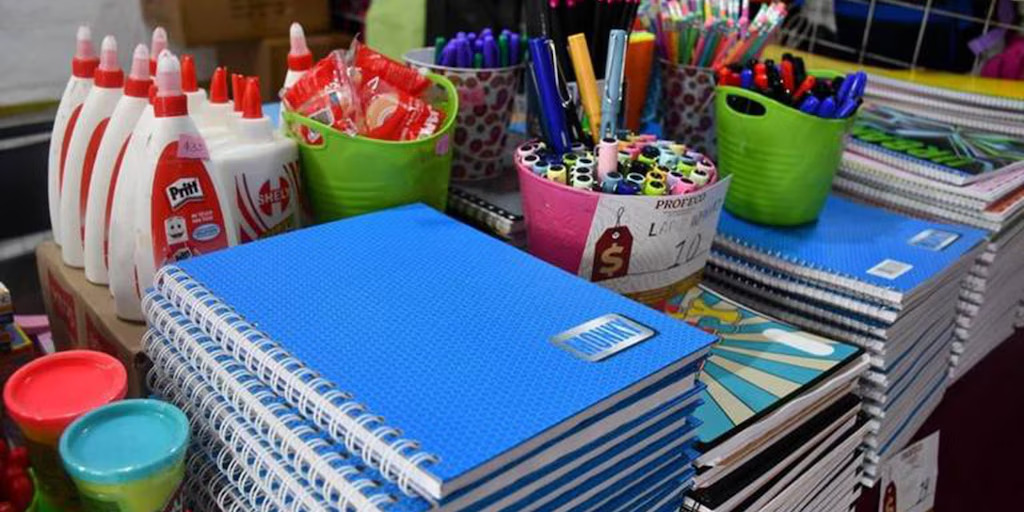
Cuando julio empieza a acabarse miles de familias venezolanas en España sienten la misma presión: uniformes, zapatos, útiles, mensualidades. En 2026 esa cuesta se ha vuelto todavía más empinada.
Qué está pasando este año con los gastos escolares
El costo de una lista escolar completa sigue subiendo por encima de los ingresos promedio de buena parte de las familias. Entre uniformes, calzado, mochilas y material didáctico, muchos padres terminan necesitando una suma que no tienen disponible de una sola vez. Ahí es donde entran los microcréditos: montos pequeños, plazos cortos y desembolsos rápidos, pensados justamente para necesidades puntuales como esta.
Cómo funcionan los microcréditos pensados para la vuelta al colegio
A diferencia de un préstamo bancario tradicional, el microcrédito no exige un historial extenso ni garantías complicadas. Muchas fintech y bancos comunales han diseñado productos específicos para este momento del año, con montos que van desde lo justo para un par de zapatos hasta lo necesario para cubrir toda la lista. El desembolso suele ser en cuestión de horas, y el pago se organiza en cuotas cortas, generalmente de cuatro a ocho semanas.
La utilidad depende del uso que se le dé
El problema aparece cuando se convierte en una costumbre, es decir, cuando cada temporada escolar termina resolviéndose a base de deuda porque el presupuesto familiar nunca logra recuperarse del año anterior. En ese escenario, la utilidad del microcrédito se diluye y el beneficio de corto plazo puede convertirse en una carga repetida.
Antes de solicitar uno, conviene hacer números
Lo más sano es comparar el costo total del microcrédito, incluyendo intereses y comisiones, contra el costo de esperar o de buscar alternativas como ropa de segunda mano en buen estado, compras compartidas entre familias o programas de donación de uniformes que varias alcaldías y fundaciones han impulsado este año. Si después de esa comparación el microcrédito sigue siendo la opción más razonable, entonces sí cumple su función.
Una herramienta, no una solución mágica
Los microcréditos pueden ser una utilidad real cuando se usan con cabeza fría, plazos claros y un propósito específico. Lo importante es que la familia mantenga el control de la deuda y no al revés.



Alcaldía de Naguanagua conmemora el Día Internacional de las Personas de Edad con jornadas de salud y recreación
CompartirAlcaldía de Naguanagua conmemora el Día Internacional de las Personas de Edad ayer jueves 1 de octubre con una serie de...


Trabajan arduamente para potenciar capacidad eléctrica en Carabobo, afirmó Lacava
CompartirEl gobernador de Carabobo Rafael Lacava, fue contundente al reiterar la consolidación de nuevos proyectos, canalizados para potenciar la carga...


Fundación Pasitos Talentosos amplía sus mecanismos para captar recursos
CompartirLa fundación Pasitos Talentosos continúa con su labor de ayudar a los más necesitados y como parte de los mecanismos...



Falleció motorizado en avenida Cedeño al impactar con camión de desechos sólidos
CompartirUna persona perdió la vida y otra resultó herida la mañana de este viernes 2 de octubre tras registrarse un...


Sismo en Sucre registró Funvisis este viernes 2 de octubre
CompartirLa Fundación Venezolana de Investigaciones Sismológicas (Funvisis) informó este viernes 2 de octubre sobre un sismo en Sucre, registrado pasado...


Enfrentamiento del ELN y militares de la GNB dejó saldo un muerto varios heridos
CompartirEnfrentamiento del ELN y militares de la GNB deja al menos un muerto y varios heridos, informó este miércoles 30 de...


Muertes bajo custodia superan 60 víctimas desde abril, denuncia OVP
CompartirMuertes bajo custodia superan las 60 víctimas desde abril de 2026, denunció el Observatorio Venezolano de Prisiones (OVP). El caso...


Rescatan a tres víctimas de secuestro virtual y extorsión
CompartirRescatan a tres víctimas de secuestro virtual y extorsión sanos y salvos, previo a labores de campo y de inteligencia...
-

 Deportes22 horas ago
Ricardo Sánchez y Tucupita Marcano se incorporaron a la Nave
-
 Deportes14 horas ago
Magallanes recibió cuatro incorporaciones en séptimo día de prácticas
-
 Deportes15 horas ago
Venezuela empató ante Corea del Sur en su gira asiática (+ video)
-

 Nacional22 horas ago
«Derecho Internacional del Mar», obra clave para comprender desafíos jurídicos